60-day clock ticking over US: All you need to know about the War Powers Act
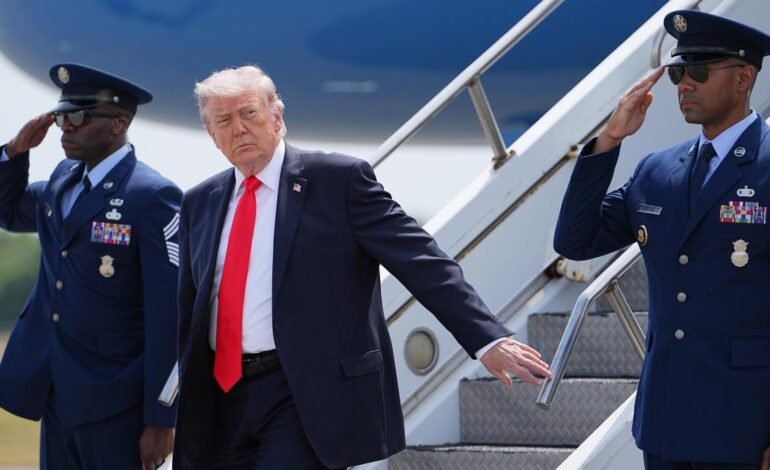


President Donald Trump arrives on Air Force One at Ocala International Airport, in Ocala Fla., on May 1, 2026.
| Photo Credit: AP
The U.S. Senate passed a war powers resolution on Tuesday (June 23, 2026) aimed at preventing military action against Iran, marking the first time such a measure has been approved. Lawmakers are cautiously monitoring President Donald Trump’s attempts to manage a conflict initiated by his administration, which now requires Congressional funding. This vote, which resulted in a narrow 50-48 outcome, represents the Senate’s 10th attempt to halt the war and also marks a significant shift from previous efforts.
This comes after Trump deploys J.D. Vance to Switzerland to negotiate a settlement aimed at resolving the conflict that the U.S. started with Israel back in February.

Let’s examine what the War Powers Act states regarding Congressional approval.
Also read: Israel-Iran war LIVE updates
What is War Powers Act?
The War Powers Resolution (WPR), passed in 1973 (despite the then-President Nixon vetoing it), is meant to strengthen Congress’s role in approving U.S. military actions abroad. It gives the president 60 days to conduct military operations without Congressional approval and allows for a possible 30-day extension if there’s a critical military need for the safety of troops.

The Iran war began with airstrikes launched by Israel and the United States on February 28. Mr. Trump formally notified Congress of the conflict 48 hours later, triggering a 60-day deadline ending on May 1.
What purpose WPR serve?
1. Section 2(a) of the War Powers Resolution states that the WPR aims to ensure that both Congress and the President collectively assess the deployment of U.S. Armed Forces into situations of conflict.
2. Section 2(b) clarifies that Congress derives its authority to legislate on war powers from the Necessary and Proper Clause of the Constitution, which empowers Congress to enact all laws deemed essential for executing the federal government’s powers, including those of the executive branch.
3. Section 2(c) states that the President’s authority as Commander in Chief to deploy U.S. Armed Forces into conflict is restricted and can only be exercised in accordance with a formal declaration of war, specific statutory authorisation from Congress, or in response to a “national emergency created by an attack” on the United States or its Armed Forces.
Also read| Temporary truce: On U.S.-Israel ceasefire with Iran
Can a ceasefire reset War Power clock?
The U.S. Constitution says only Congress, not the President, can declare war, but the curb does not apply to operations the administration casts as short-term or countering an immediate threat.

Democrats have tried since the war began to pass resolutions to force Mr. Trump to withdraw U.S. forces or obtain congressional authorisation. Almost every week that Congress is in session, Senate Democrats have introduced war powers resolutions; however, they have struggled to secure the majority required for approval in the closely divided chamber, where the Republican Party, led by Mr. Trump, holds the majority.
Earlier this month, the House advanced its own version of the war powers resolution, with four Republicans voting alongside all Democrats in favor, despite opposition from House Speaker Mike Johnson and the Republican leadership.
Meanwhile, Mr. Trump has struck a deal with Iran, and the terms of the Iran deal are outlined in a Memorandum of Understanding, starting a 60-day clock for the sides to reach a broader agreement over ending Iran’s nuclear programme.
(With ANI inputs)
Published – May 02, 2026 10:25 am IST